What are the types of septic systems in Tennessee?
The main types of septic systems in Tennessee are conventional, chamber, low pressure pipe, mound, aerobic treatment and drip. Williamson County’s regulations list those six and permit no other type. There, the Modified Wisconsin Mound is an experimental system for repairs only. Your soil and the permit office decide which one your lot gets.
Which septic systems do Tennessee and Williamson County allow?
Williamson County runs its own septic program through the Department of Sewage Disposal Management in Franklin. Section 5 of its regulations lists six system types and permits no other:
- Conventional
- Chamber, 36-inch only
- Low pressure pipe (LPP), standard or modified
- Mound (the county’s mound appendix is marked Reserved)
- Advanced treatment systems (ATS), the aerobic units
- Subsurface drip
Maury, Marshall, Rutherford and Dickson counties permit through the Tennessee Department of Environment and Conservation (TDEC) under state rule 0400-48-01. That rule covers all six too.
In Williamson County, the county department designates which type fits each property. The system that goes in has to match the permit, and our septic system installation page covers how an install runs.
The six types on Williamson County’s list; upkeep shows only what the rules say.
| System | How it treats and spreads the water | Williamson County status | Upkeep in the rules |
|---|---|---|---|
| Conventional | Septic tank and a trench or bed drain field; county trenches 36 inches wide, 24 to 30 inches deep | Allowed | County recommends pumping the tank every 2 to 5 years |
| Chamber | Plastic arch-shaped, open-bottomed chambers in place of gravel | Allowed as the one conventional substitute, 36-inch chambers only | County recommends pumping the tank every 2 to 5 years |
| Low pressure pipe (LPP) | Even distribution, dosing and resting cycles, shallow trenches | Allowed as standard LPP or modified LPP (with soil modification) | County: a high water alarm on the pump |
| Subsurface drip | Pressurized drip line in the top 6 to 12 inches of soil, fed by a dose tank | Allowed, always behind an ATS that reaches secondary treatment | County: the ATS contract and three-month service, plus a high water alarm on the pump |
| ATS (aerobic) | Injects oxygen into the treatment tank, like a small municipal sewage plant | Allowed for NSF Standard 40 units only | Service every three months; county: a contract for the life of the system, reviewed every year |
| Mound | Suitable fill above the natural soil surface, dosed from a pump chamber | Listed, but its appendix is marked Reserved; the Modified Wisconsin Mound is experimental, for repairs only, with a legal agreement and a restrictive covenant | County: a high water alarm on the pump |
How does a conventional septic system work?
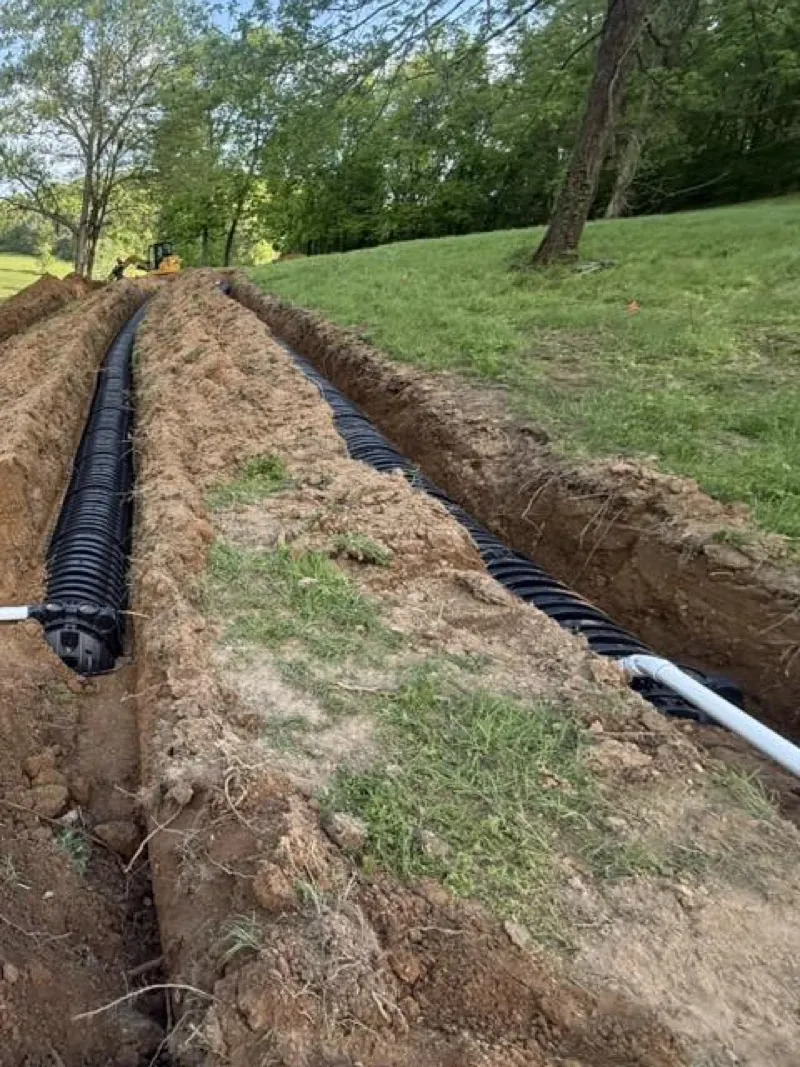
The EPA describes a conventional system as a septic tank plus a trench or bed drain field. Water leaves the tank and soaks into the soil there.
In the TDEC counties, the state rule sizes a conventional field from a soil map by an approved soil consultant. Absorption rates of 10 through 75 minutes per inch are acceptable for a conventional system under that rule.
Williamson County has its own regulations for the trench. A conventional trench there is 36 inches wide and 24 to 30 inches deep. Its bottom is dug as level as possible, with 2 inches of total fall at most over 100 feet. The field also needs at least 36 inches of natural soil over bedrock.
Whether your soil passes is up to the soil evaluation. Our perc test guide covers it.
What are chamber and gravelless pipe systems?
Both replace the gravel in a conventional trench. Under the state rule, a chamber septic system uses plastic arch-shaped, open-bottomed chambers in place of gravel.
The same rule names large diameter gravelless pipe. That is 8 or 10 inch perforated corrugated pipe, laid in place of 4-inch pipe and gravel.
The EPA says the main advantage of chambers is easier delivery and construction. It also calls chamber systems well suited to areas with high groundwater tables.
Williamson County is narrower. Its regulations make the chamber the one conventional substitute, and only the 36-inch chamber qualifies. Gravelless pipe is not on the county list.
When does a lot get a low pressure pipe system?
Low pressure pipe, or LPP, goes in when the soil evaluation and the permit call for it. The state rule lists three ways LPP differs from a conventional system:
- The effluent is spread evenly across the field.
- It goes out in dosing and resting cycles.
- The trenches are placed shallow.
Williamson County’s list has two regular kinds. Standard LPP needs no soil modification. Modified LPP, or MLPP, requires soil modification. The county decides which one fits the lot.
Under the state rule, the dosing runs on a pump. In Williamson County, every pump installation needs a high water alarm. Our septic pump repair service covers the pump, floats, control panel and alarm.
How do aerobic treatment and drip systems work?
An aerobic treatment unit is one kind of advanced treatment system, or ATS, which the state rule defines as a secondary treatment device. The EPA says an aerobic unit works like a small municipal sewage plant. It injects oxygen into the treatment tank. The state rule and Williamson County’s regulations only consider units tested to NSF Standard 40.
Under the state rule, a drip septic system spreads treated water through pressurized drip line in the upper soil. The EPA puts the drip lines in the top 6 to 12 inches of soil. Drip also needs a large dose tank and electrical power, the EPA says.
In Williamson County, a drip system is always preceded by an ATS that reaches secondary treatment. The state rule also puts a secondary treatment device ahead of drip, unless the department decides otherwise.
ATS service runs every three months under the state rule and in Williamson County. The state rule has the maker sign a four-year service contract with the homeowner, priced into the install. Williamson County requires a contract with an approved Qualified Service Provider for the life of the system.
The county reviews those contracts every year, and a lapse is a Class C misdemeanor with civil penalties. The duty runs with the land and binds every future owner. Buying a house with an ATS? Book a home-buyer septic inspection before you close.
Where do mound systems fit in Tennessee?
Under the state rule, a mound septic system sits above the natural soil surface, built with suitable fill. The EPA says effluent flows from the septic tank to a pump chamber, then to the mound in doses. It lists mounds as an option where soil is shallow, groundwater is high or bedrock is shallow.
Williamson County treats the mound differently. Its regulations list the Modified Wisconsin Mound as one of two experimental systems, next to MLPP with extra modification. Experimental systems are for repairs only, on existing homes where no standard system fits the soils. Each one also needs a legal agreement with the county and a restrictive covenant.
The county’s appendix for mound systems is marked Reserved. If the field on an existing home fails, start with drain field repair.
Who decides which septic system your lot gets?
The soil comes first. In the TDEC counties, the soil map from an approved soil consultant sizes a conventional field. In Williamson County, the Department of Sewage Disposal Management designates the system type for each property.
The house sets the size. The state rule sizes an alternative septic system on 150 gallons per bedroom per day. Under that rule, a large alternative system over 750 gallons per day needs a design stamped by a licensed engineer.
We coordinate the soil evaluation and handle the permit start to finish, in whichever office your address calls for. The system that goes in then follows the permit. Our guide to septic permits in Williamson County lists the steps.
Frequently asked questions
What is the best type of septic system to install?
The best septic system is the one your soil and permit call for. In Williamson County, the county department designates the type for each property. In the TDEC counties, a soil map by an approved soil consultant sizes a conventional field. The installation then follows the permit.
What is the cheapest type of septic system?
Where the soil allows one, it is a conventional gravity system, and our septic system cost guide lists published prices by type. The EPA notes that drip needs a large dose tank and electrical power, an added expense. Our on-site estimates are free.
What is the most efficient septic system?
It depends on what you measure. An aerobic unit, one kind of ATS, adds a treatment step that the EPA likens to a small municipal sewage plant. Drip then spreads that treated water through pressurized drip line in the upper soil. Both need upkeep: ATS service runs every three months under the state rule and in Williamson County.
Can a septic system work without a leach field?
Every type on Williamson County’s list is a subsurface sewage disposal system, so the water from the tank goes into the soil. Drip swaps trenches for pressurized drip line in the top 6 to 12 inches of soil, per the EPA. In the county, drip always follows an ATS.
Are aerobic septic systems allowed in Tennessee?
Yes, with conditions. The state rule treats them as advanced treatment systems, or ATS, and only considers units tested to NSF Standard 40. Williamson County holds to the same standard. Service runs every three months. Williamson County also requires a service contract with an approved provider for the life of the system.
Can I choose which septic system goes on my lot in Williamson County?
The county makes that call. Under Section 5 of its regulations, the county department designates which type fits each property. No type outside the county’s list of six is permitted. The soil evaluation drives that decision, and the installation follows the permit.
Septic Superior is a family septic company based in Thompson’s Station. We coordinate the soil evaluation and handle the permit start to finish. See our septic installation and replacement page or fill out the contact form. Call (615) 957-9682 for a free on-site estimate. We look at the site and hand you one price.