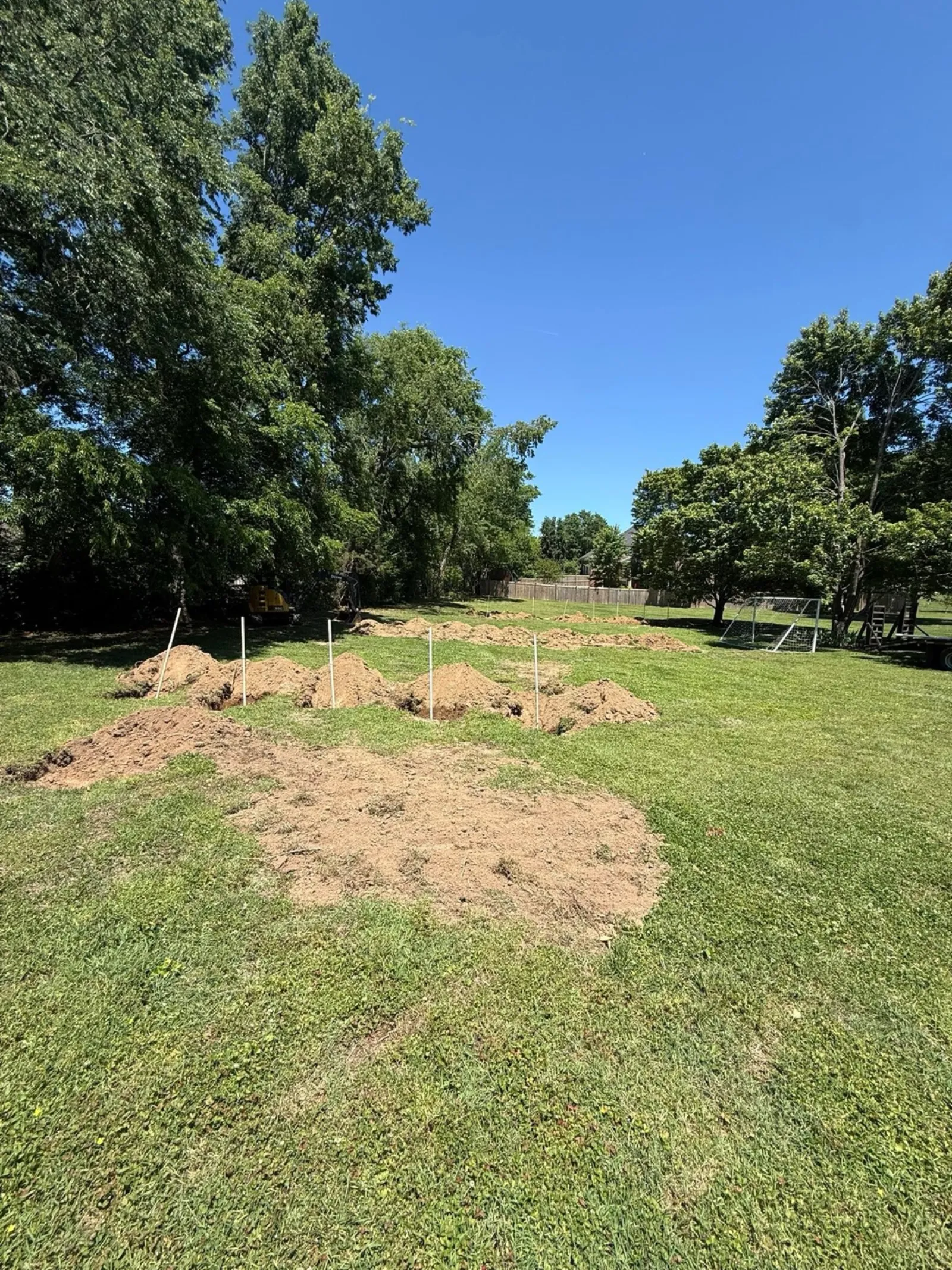
Do you need a perc test in Tennessee, and what happens if your lot fails?
Usually you do not. In Tennessee most lots are approved on a soil evaluation, not a classic perc test. An approved soil consultant maps the soil, or a county or state soil scientist evaluates the site. A percolation test comes second, and only where the permit office allows it.
What is a perc test, and does Tennessee still use one?
A perc test, or percolation test, measures how fast water soaks into the ground. The tester digs holes, fills them with water, and times the drop. The result is written in minutes per inch, or MPI. Slower soil needs a bigger drain field.
Tennessee still allows the test, but it is not the front door. Williamson County’s regulations recognize three approved methods of land assessment. They are soil mapping, percolation tests, and an Individual Lot Assessment run by the county. Soil mapping is the common path, and the regulations say perc testing may follow an approved soil map.
Most people searching for a perc test really need a soil evaluation. That reading of the ground shapes the septic system installation that follows.
Who performs a perc test or soil evaluation in Tennessee?
Soil mapping is done by a soil consultant approved by the state through TDEC. The Department of Commerce and Insurance no longer licenses soil scientists.
A percolation test has a wider list. Williamson County’s regulations let any of these run one:
- an approved soil scientist
- a registered land surveyor
- a registered professional environmentalist
- a registered or professional geologist
- a licensed engineer in Tennessee
In the counties TDEC permits, a TDEC Environmental Scientist conducts the site evaluation. That scientist may ask for a soils map from a private consultant. In Williamson County, the county’s own soils staff handles the assessment.
The soil evaluation belongs to those people. We line it up and file the permit. Then we install the septic system once the ground is approved.
What does the soil evaluation actually check?
The evaluation reads the dirt itself. Williamson County’s regulations set hard numbers for a site:
- at least 36 inches of natural soil over bedrock or the upper limit of any water table
- at least 24 inches of unencumbered soil over a non-rock restrictive horizon, such as a fragipan or clay horizon
- a natural slope no greater than 30 percent
- natural, undisturbed soil, since a system cannot go in fill or compacted ground
Absorption rate matters too. The county lists estimated rates of 15, 30, 45, 60 and 75 MPI as usable for a conventional system. Faster than 15 MPI is not allowed. Slower than 75 MPI is not approved for conventional use. Where the county specifically approves percolation testing, tested rates of 76 to 105 MPI may be used.
The lot also has to hold two areas. One is the field that gets installed. The other is a duplicate area, reserved for a future repair, never the first install.
Is a perc test required in Williamson County?
Not by default. Williamson County runs its own septic program through the Department of Sewage Disposal Management in Franklin. It is one of nine Tennessee contract counties. Most counties around it permit through TDEC instead. The state law is the same. The office and the paperwork are not.
The county’s regulations leave the choice of method with the department. Percolation testing comes up where soils are estimated slower than 75 MPI and the county approves that method. Perc testing is also limited to single-family homes.
On raw land with nothing on file, the county will run an Individual Lot Assessment when the owner asks. That look is typically limited to about two to four acres near the house site, conventional systems only. The permit steps that follow are in our guide to septic permits in Williamson County.
What does a perc test cost in Tennessee?
Angi’s 2026 perc test guide puts most tests at $750 to $1,900, with an average near $1,300. The same guide prices a single hand-dug hole from about $300. Machine-dug holes on a one-acre lot run up to about $3,000 in that guide.
Consultant fees sit outside that. The county regulations say private surveyor, engineer and soil scientist fees are separate from department fees.
Permit fees are separate again. TDEC’s fee schedule lists $400 for a new conventional system permit, plus $100 for the construction inspection. An alternative permit is $500, plus $200. A repair permit carries no fee. Williamson County sets its own fees through the county Board of Health.
Full system pricing lives in our septic system cost guide for Tennessee. Our estimates are free, and we hand you one price.
Land assessment paths in Middle Tennessee: who runs each one and what it costs
| Path | Who runs it | What it costs | Notes |
|---|---|---|---|
| Soil map (general or high intensity) | A TDEC-approved soil consultant | Consultant sets the fee, separate from permit fees | Reassessed five years after the map was completed |
| Percolation test | Approved soil scientist, land surveyor, professional environmentalist, geologist or licensed engineer | Angi’s 2026 guide: most tests $750 to $1,900, average about $1,300 | Follows an approved soil evaluation; in Williamson County, only where the department approves it |
| Individual Lot Assessment | Williamson County soils staff, by request | A county service; ask the office about the current fee | About two to four acres near the house site, conventional systems only |
| Site evaluation in TDEC counties | A TDEC Environmental Scientist | TDEC fee schedule: $400 conventional permit plus a $100 construction inspection | TDEC says a permit can take up to 45 days from a complete application |
What does it mean if land fails a perc test?
It means the ground will not take effluent at an approved rate, or the site misses a county minimum. Shallow rock, a clay horizon, a high water table or steep ground can all end a conventional design. Middle Tennessee is karst country, so shallow limestone is common.
A fail still leaves options. Williamson County’s regulations approve other system types where the soil supports them. Low pressure pipe and mound are the listed alternative systems. The county’s mound appendix is marked Reserved, and the one mound design it names, the Modified Wisconsin Mound, is an experimental system limited to repairs. Subsurface drip disposal and advanced treatment have their own sections. Our guide to types of septic systems in Tennessee compares them.
Those systems come with strings. The application cannot move forward until the department approves engineered design plans. An engineer prepares that design.
Some parcels get nothing. Where the department finds no area able to support a conventional system, the permit is not issued.
What should you check before you buy land in Middle Tennessee?
Get the soil work done before you close. A soil map may already be on file for the parcel. Williamson County’s regulations call for reassessment five years after the map was completed. A percolation test also expires at five years, unless it supported a subdivision plat or a construction permit.
In Williamson County the minimum platted subdivision lot is one acre. That lot still has to fit the first system plus its repair area. Under the state rule, perc-tested lots need 20,000 square feet on public water. A private water supply raises that to 25,000 square feet.
TDEC asks owners to mow or bush hog the house site and the proposed evaluation areas. Stake the property lines and house corners, and bring any earlier soil maps. Leave the soil uncut and unfilled.
Buying a house that already has a system is a different job. That one calls for a septic inspection.
Frequently asked questions
How much does a perc test cost?
Angi’s 2026 perc test guide puts most tests at $750 to $1,900, with an average around $1,300. A single hand-dug hole starts near $300. Machine-dug holes on a one-acre lot can reach about $3,000. Consultant and permit fees are separate. Our estimates are free, and we hand you one price for the install.
What does it mean if land fails a perc test?
It means the soil will not accept effluent at an approved rate. It can also mean the site misses a minimum, such as soil depth or slope. Williamson County still approves other system types where the soil supports them. Low pressure pipe, mound, subsurface drip and advanced treatment all appear in the regulations.
Can I perform my own perc test?
No. A homeowner’s bucket and stopwatch test carries no weight with the permit office. Williamson County’s regulations name who may run one. The list covers approved soil scientists, registered land surveyors, registered professional environmentalists, registered or professional geologists, and licensed engineers. The test also follows a prescribed procedure in the regulations.
What does a perc test tell you?
It tells the permit office how fast water moves through the soil, in minutes per inch. That rate helps set the drain field size. In Williamson County, estimated rates of 15, 30, 45, 60 and 75 MPI can carry a conventional system. The rate decides whether a conventional field is allowed at all.
Is a perc test required to build in Tennessee?
Usually not. The requirement is an approved land assessment, usually soil mapping by an approved consultant. Under the state rule, a percolation test comes only after a general or high intensity soil evaluation. That evaluation must find at least 24 inches of undisturbed soil. It also needs slopes of 30 percent or less and no water problem.
Who performs a perc test near me in Middle Tennessee?
TDEC keeps a public list of approved soil consultants, with consultants based in Franklin, Spring Hill, Columbia and Murfreesboro. In Williamson County, the county’s own soils staff also assesses lots. The state rule calls for three days notice to the department before a percolation test. We line the work up for your install.
How long is a soil map or perc test good for?
Williamson County’s regulations require a soil map to be reassessed five years after it was completed. A percolation test also expires at five years, unless it supported a subdivision plat or a construction permit. Older mapping can face a full reassessment before the county will use it.
We coordinate the soil evaluation as part of a full septic system install. We file the permit with the right office and build what the approval calls for. Call (615) 957-9682 or ask for a free on-site estimate. We look at the site and hand you one price.