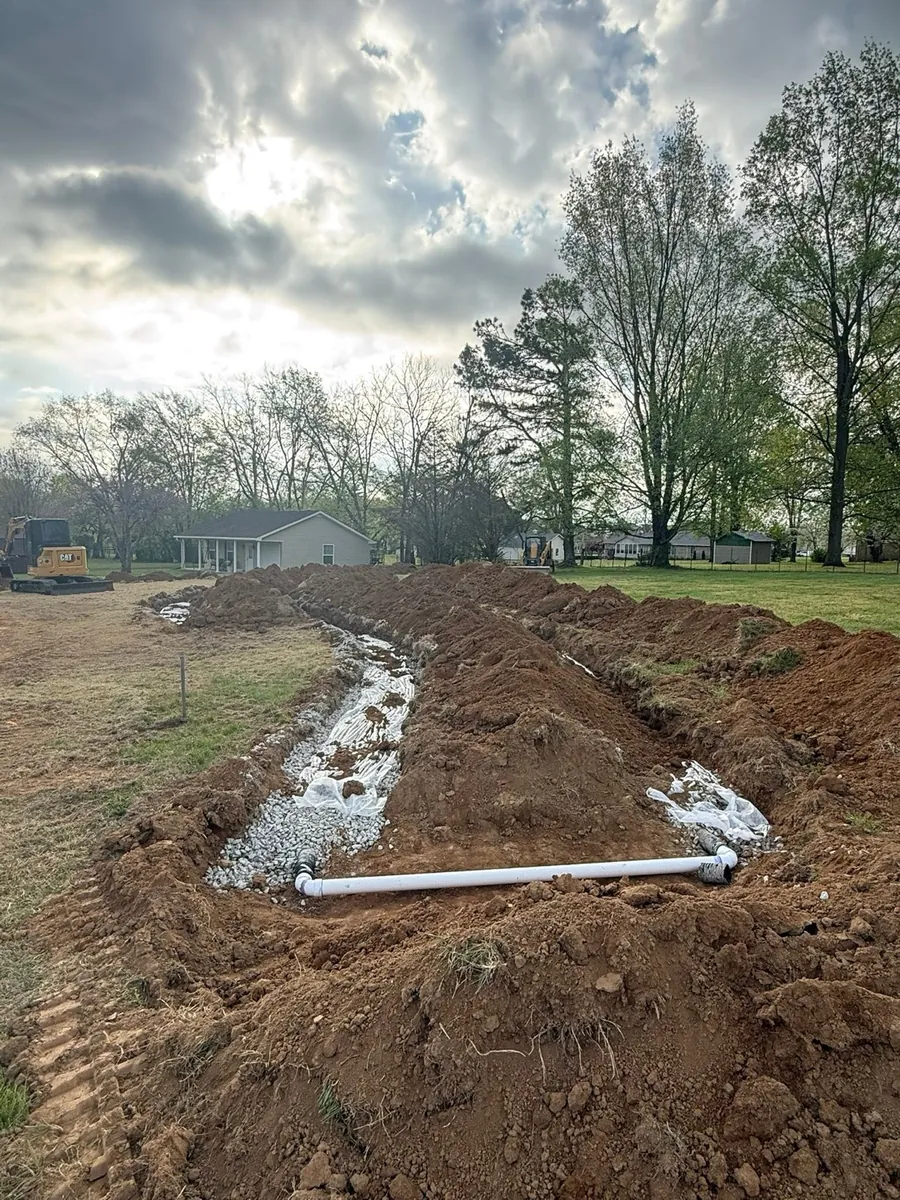
How much does drain field replacement cost in Tennessee?
Drain field replacement costs $5,000 to $15,000 for a conventional system, per The Septic Guide’s 2026 cost guide. Angi’s 2026 guide puts it at around $7,000. Both are national figures. The Septic Guide lists a mound system replacement at $10,000 to $20,000. Your soil and permit office set the real number. Our on-site estimates are free.
What does it cost to replace a drain field in Tennessee?
Three published sources give close numbers. The Septic Guide’s 2026 cost guide puts conventional drain field replacement at $5,000 to $15,000. Angi’s 2026 guide says replacing a drain field costs around $7,000. The EPA says repairing or replacing a malfunctioning conventional system can cost $5,000 to $15,000.
All three are national figures. Our drain field repair and leach field replacement service starts by finding what failed.
If the tank fails too, Angi’s 2026 guide puts a tank and field replaced together at $5,000 to $12,000. That job is a full septic system replacement. Our guide to what a new septic system costs in Tennessee covers that budget. The on-site estimate for either job is free.
How does leach field replacement cost change by field type?
Field type moves the price most. In The Septic Guide’s 2026 cost guide, a conventional drain field installation runs $3,000 to $10,000. Mound system construction runs $10,000 to $20,000 in the same guide.
In Williamson County, the county department has the authority to designate the system type for each property. Its regulations call slopes over 30 percent unsuitable for conventional and low pressure pipe systems. For drip, the line is 35 percent. Our guide to types of septic systems in Tennessee explains each one.
Drain field replacement cost by field type and line item, from two national 2026 cost guides.
| Field type or line item | Published range | Source |
|---|---|---|
| Conventional drain field replacement | $5,000 to $15,000 | The Septic Guide, 2026 |
| Mound system replacement | $10,000 to $20,000 | The Septic Guide, 2026 |
| Conventional drain field installation | $3,000 to $10,000 | The Septic Guide, 2026 |
| Chamber system drain field | $4,000 to $12,000 | The Septic Guide, 2026 |
| Drip distribution | $8,000 to $18,000 | The Septic Guide, 2026 |
| Distribution box replacement | $500 to $1,500 | The Septic Guide, 2026 |
| New septic line, tank to field | $40 to $180 per linear foot | The Septic Guide, 2026 |
| Excavation and site prep | $1,500 to $5,000 | The Septic Guide, 2026 |
| Old field excavation and fill | $1 to $5 per square foot | The Septic Guide, 2026 |
| Landscaping restoration | $500 to $3,000 | The Septic Guide, 2026 |
| Tree removal | $200 to $2,000 | Angi, 2026 |
What moves the new drain field cost on a Tennessee lot?
In Williamson County, the soil absorption rate dictates the field’s length and area. On a perc-tested site, a conventional field gets at least 405 square feet of trench bottom per bedroom.
The county sets the trench too: 36 inches wide and 24 to 30 inches deep. A conventional field needs at least 36 inches of natural soil over bedrock. The TDEC counties follow the state rule instead.
Setbacks decide where the field fits. The county’s setback chart keeps a disposal field at least 50 feet from a water supply. It also sits at least 10 feet from a dwelling and 25 feet from sinkholes, streams and natural drainageways.
Site work adds its own lines. Tight access, trees, yard restoration and a new distribution box or tank-to-field line all raise the bill. We price the whole job on one free on-site estimate.
Where does the replacement field go on your lot?
The rules plan for a second field from the start. In the TDEC counties, the state rule says a lot must hold the system plus an area to duplicate it. Williamson County’s regulations require extra undisturbed, acceptable soil for a complete replacement of a conventional field.
The county calls that ground the duplicate area, also known as the backup or secondary area. It is never used for the first installation. The county reserves it for future repair installations on that property.
Sewer changes the math in Williamson County. The county issues no septic repair permit where a property has access to public sewer. Inside a city or town that provides sewer, it requires a sewer connection at the property owner’s expense.
What do drain field permits cost in Tennessee?
National guides price permits well above TDEC’s repair fees. The Septic Guide’s 2026 cost guide lists permits at $250 to $650. Angi’s 2026 guide puts them at $450 to $2,000.
In the TDEC counties, repairing a faulty system takes a Septic System Construction Permit. TDEC’s fee schedule lists no fee for the repair permit and $100 for the repair construction inspection.
Williamson County permits through its own Department of Sewage Disposal Management. You start with the county’s online application, choosing Technical Assistance: System Failure or Repair. The department investigates and decides whether the system needs replacement, then a repair permit is required. Fees are set by the county Board of Health and listed at the department’s offices. Baffle, riser lid and switch valve repairs need no permit there.
We file the permit in whichever office your address calls for. Our guide to septic permits in Williamson County lists the steps.
What does drain field repair cost when the field can be saved?
Some fields can be rescued, but only early. The Septic Guide’s 2026 cost guide puts soil aeration or fracturing at $1,000 to $3,000. It is for early biomat buildup or compacted soil only. A full rejuvenation package runs $2,000 to $5,000 there. It does not work once a field reaches end of life.
Age is the clue. The same guide says a well-maintained drain field typically lasts 15 to 30 years. The EPA says the biomat in a field can thicken after 25 to 30 years. Williamson County’s repair page lists these warning signs:
- Bright green, spongy grass over the tank or drain field, even in dry weather
- Standing water or damp spots over the tank or field
- Gurgling sounds in the plumbing
A full tank can finish a field early. The EPA says solids that leave a full tank can clog the drain field and force a full replacement. Regular septic tank pumping guards against that. If the tank is the question, see our guide to septic tank repair versus replacement.
Frequently asked questions
How much does it cost to fix a drain field?
It depends on how far the field has failed. The Septic Guide’s 2026 cost guide puts soil aeration at $1,000 to $3,000 and full rejuvenation at $2,000 to $5,000. Neither helps a field at end of life. Angi’s 2026 guide puts a replaced field at around $7,000. Our on-site estimate is free.
Will homeowners insurance cover a new drain field?
Almost never. The Septic Guide’s 2026 cost guide says drain field replacement is almost never covered by standard homeowners insurance. Check your own policy with your agent before you count on it. Plan for the cost as part of owning a septic system. Our on-site estimate is free.
Can you just replace a leach field?
Yes, if the tank is still sound. In the TDEC counties, the state rule requires a repair permit for tanks, field line or both. Williamson County defines a repair as replacing a failed system or any part of it. Angi’s 2026 guide puts replacing a drain field at around $7,000. Our on-site estimate is free.
How many years does a septic leach field last?
The Septic Guide’s 2026 cost guide says a well-maintained drain field typically lasts 15 to 30 years. The EPA says the biomat can thicken after 25 to 30 years, so the field takes less water. Solids from a full tank can clog a field sooner, the EPA adds, so keep the tank pumped.
How big is a leach field for a 3 bedroom house?
It depends on the soil rating. On a perc-tested Williamson County site, a conventional field gets at least 405 square feet of trench bottom per bedroom. For three bedrooms, that is at least 1,215 square feet. In the county’s 36-inch trenches, that comes to about 405 feet of trench. A soil-mapped site is sized by its own rating.
Do I need a permit to replace my drain field?
Yes. In the TDEC counties, repairing a faulty system takes a Septic System Construction Permit. TDEC’s fee schedule lists no fee for the repair permit and $100 for the repair construction inspection. Williamson County investigates first, then requires a repair permit. Baffle, riser lid and switch valve repairs need no permit there. Our on-site estimate is free.
Can you replace a drain field yourself?
The permit comes first. Williamson County’s regulations name who may request a repair permit. The list is the property owner, a licensed septic installer, a building contractor or their agent. The county department investigates and decides whether the system needs replacement. The county also points owners with a failing system to its verified list of service providers.
Septic Superior is a family septic company based in Thompson’s Station. There are more than 20 years of septic work in Williamson County behind the company. We replace failed drain fields and handle the permit start to finish. See our drain field repair service or send the contact form. Call (615) 957-9682 for a free on-site estimate. We look at the site and hand you one price.