How much does sewer line replacement cost in Tennessee?
Sewer line replacement costs $50 to $250 per linear foot, per HomeGuide’s 2026 guide. Most full replacements are around 40 feet, which HomeGuide puts at $2,000 to $10,000. Angi’s 2026 guide puts the average replacement at $3,319. Both are national figures, and our on-site estimates are free.
What is the cost to replace a sewer line per foot?
HomeGuide’s 2026 guide puts sewer line replacement at $50 to $250 per linear foot on average. It lists $2,000 to $10,000 for 40 feet, the length of most full replacements. It also notes a partial replacement may cover only 1 to 15 feet.
Angi’s 2026 guide says sewer line replacement costs $3,319 on average. In Angi’s guide, the cost often ranges from $225 to $10,000. Angi says professional replacement typically costs $1,388 to $5,323. It prices new pipe at about $150 per linear foot on average, materials and labor included.
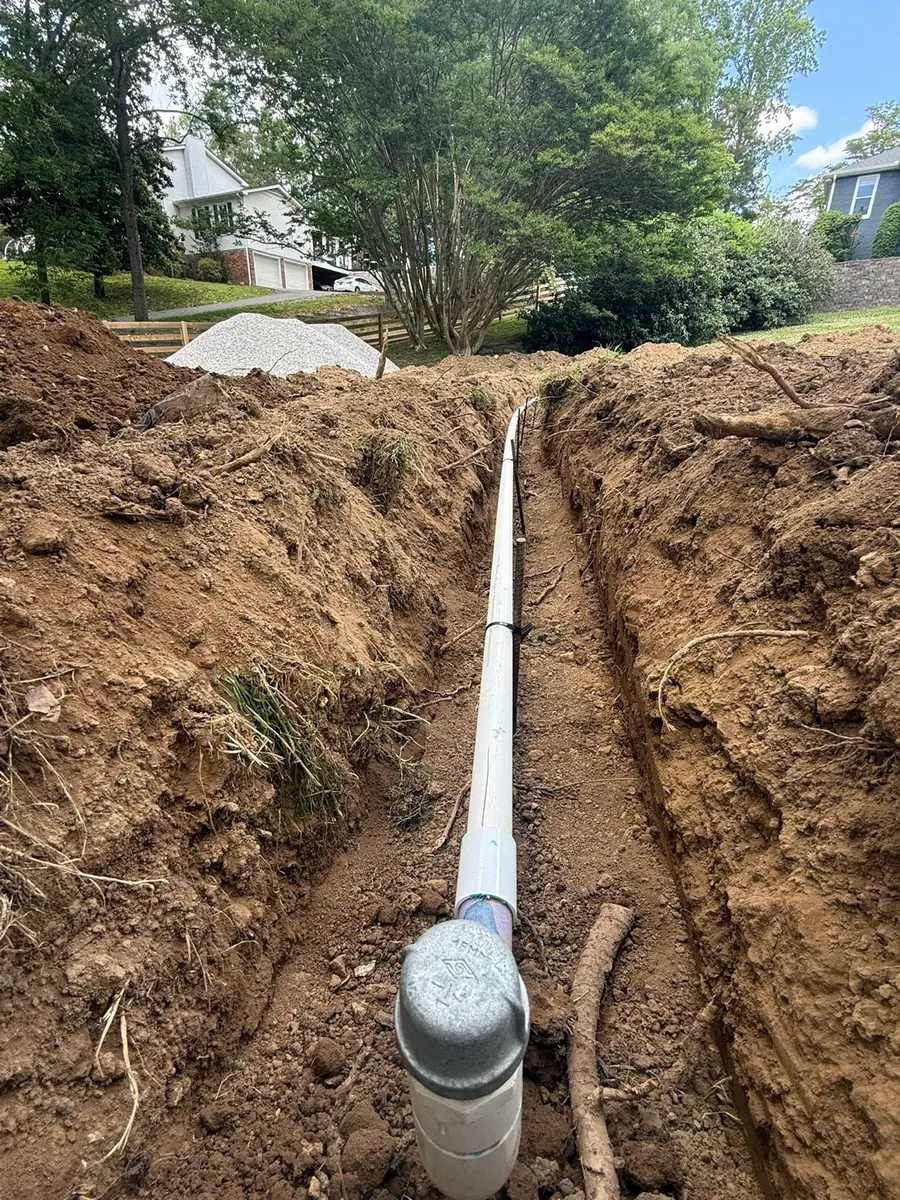
For most of our customers, the sewer line is the pipe from the house to the septic tank. Our sewer and water line repair and replacement work replaces that pipe in an open trench. The on-site estimate for that work is free.
HomeGuide’s 2026 guide lists sewer line replacement cost by the length of pipe replaced.
| Length of sewer line | HomeGuide 2026 range |
|---|---|
| 10 feet | $500 to $2,500 |
| 20 feet | $1,000 to $5,000 |
| 40 feet | $2,000 to $10,000 |
| 60 feet | $3,000 to $15,000 |
| 80 feet | $4,000 to $20,000 |
How does sewer line repair cost compare with a full replacement?
A repair fixes one bad section instead of the whole run. HomeGuide’s 2026 guide puts sewer line repairs at $150 to $3,800, depending on the method. A full 40-foot replacement runs $2,000 to $10,000 in the same guide.
Not every backup comes from the line. Some start at the tank instead. Cracked tanks, baffles and effluent filters fall under septic tank repair, a separate job with its own price.
Where a sewer line job lands depends on how much pipe has to come out. Our on-site estimate is free for a repair or a full replacement.
What else adds to sewer line replacement cost?
The guides price these line items on their own:
- Trench digging: HomeGuide’s 2026 guide puts it at $5 to $12 per linear foot. Angi’s 2026 guide says trenching alone adds $4 to $12 per linear foot.
- Concrete: HomeGuide adds $3 to $8 per square foot for concrete removal. Angi says a slab section that must be broken up and restored can run $300 to $350 per linear foot.
- Yard repair: HomeGuide puts sod at $1 to $2 per square foot and tree removal at $400 to $1,200.
- Cleanout: HomeGuide says adding a sewer cleanout costs $500 to $2,000.
- Permits: HomeGuide puts plumbing permits at $30 to $500, depending on the project and local prices.
- Inspection: HomeGuide prices a sewer camera inspection at $125 to $500. Angi says most sewer line projects need a video inspection, at $100 to $500.
Trenching for water and sewer lines is part of our excavation services. The dig and the new pipe come in one price, from a free on-site estimate.
When does a sewer line need an open trench?
The cost guides also price trenchless methods. HomeGuide’s 2026 guide puts pipe bursting at $60 to $200 per linear foot. It puts cured-in-place pipe lining at $90 to $250 per linear foot. Angi’s 2026 guide puts trenchless replacement at $60 to $250 per linear foot, materials and labor included.
Trenchless work has limits. Angi says trenchless methods are not suitable for pipes with major problems, such as collapse or improper sloping. Those lines need traditional excavation.
Our work is the open trench. We dig out the old line and set new pipe at the right fall.
What is the water line replacement cost from the street to the house?
HomeGuide’s 2026 water line guide puts main water line replacement at $2,000 to $5,000 on average. In that guide, a trenched line costs $50 to $200 per linear foot installed. Trenchless water line replacement runs $70 to $250 per linear foot in the same guide. HomeGuide puts a water line repair at $400 to $1,500.
Most service lines from the street to the home are 3/4 to 1 inch in diameter, per HomeGuide. The H.B. and T.S. Utility District serves Thompson’s Station, Leiper’s Fork and Burwood. The district says it is responsible up to the point of connection with the customer’s private water line. Its meters sit in a buried meter box near the front property line.
The district says pressure regulators are a necessity for most homes in its area, due to the hills and valleys. HomeGuide prices a regulator replacement at $150 to $350, which may be required with a new main water line. It puts a main shut-off valve replacement at $250 to $600. Our on-site estimate for a new water line is free.
What does Tennessee 811 cover before a line is dug up?
Every dig starts with a locate ticket. The Tennessee Public Utility Commission says each person responsible for excavating must obtain one from Tennessee 811. When we do the digging, we get the ticket.
Tennessee 811 says a normal locate request needs at least three working days’ notice. That is 72 hours, not counting weekends and holidays. The Commission says there is no charge for requesting utility markings.
Tennessee 811 also says the utilities may not locate or mark private underground lines. That covers your own sewer and water service lines, so those have to be found another way.
What septic rules shape a sewer or water line route?
In Williamson County, the pipe from the house to the septic tank follows the county’s building and plumbing codes. Those codes set its cleanouts and minimum pipe size. The county’s setback chart keeps that house-to-tank connection 10 feet from the disposal field.
Water lines face more rules there. The county’s Section 15 says a water line may not cross, pass through or go under the disposal field. It may not come within 10 feet of the field, the tank, the tight line or a curtain drain. Crossing a tight line takes an advance written request to the county department, with construction drawings.
In the surrounding counties that permit through TDEC, state rule 0400-48-01 applies. It also keeps water lines from crossing, passing through or going under the disposal field. A water line may cross a tight line only inside one continuous 20-foot sleeve of Schedule 40 PVC. The water line must sit at least 1 foot above the tight line.
Under paved areas or driveways, tight lines must be Schedule 40 PVC or equivalent, at least 3 inches inside diameter. Our guide to septic permits in Williamson County explains how the county’s own permit office works.
Frequently asked questions
Is it cheaper to repair or replace a sewer line?
A repair usually costs less when the damage sits in one spot. HomeGuide’s 2026 guide puts sewer line repairs at $150 to $3,800 and a full 40-foot replacement at $2,000 to $10,000. Angi’s 2026 guide says a collapsed or badly sloped pipe needs traditional excavation. Our on-site estimate is free.
Can a sewer line be replaced without digging?
The 2026 cost guides price trenchless methods for that. HomeGuide prices pipe bursting at $60 to $200 per foot and cured-in-place lining at $90 to $250 per foot. Angi’s 2026 guide says trenchless methods do not suit a collapsed or badly sloped pipe. Our work is the open trench, with a free on-site estimate.
Does homeowners insurance cover sewer line replacement?
Usually not for wear and tear. HomeGuide’s 2026 guide says homeowners policies differ, but most do not cover wear and tear due to lack of maintenance. The same guide notes that separate sewer line coverage exists. Whatever your policy says, our on-site estimate is free and gives you one price for the work.
Who is responsible for the water line from the street to the house?
Usually the homeowner. HomeGuide’s 2026 guide calls the city’s line the water main and the homeowner’s line the water service line. The H.B. and T.S. Utility District serves Thompson’s Station. It says it is responsible up to the point of connection with the customer’s private water line.
How much does it cost to replace the main water line to your house?
HomeGuide’s 2026 water line guide puts main water line replacement at $2,000 to $5,000 on average. It prices a trenched line at $50 to $200 per linear foot installed. A trenchless line runs $70 to $250 per foot in the same guide. Our on-site estimate is free.
How long does it take to replace a sewer line?
HomeGuide’s 2026 guide says replacing or repairing a sewer line takes 1 to 5 days on average. The utility marks come first: Tennessee 811 says a normal locate request needs at least three working days’ notice. That is 72 hours, not counting weekends and holidays. Rock in the trench can add time.
How long do sewer lines last?
HomeGuide’s 2026 guide says sewer lines last 30 to 100 years, depending on the material. It puts outdated Orangeburg and clay pipe at 30 to 60 years. PVC, cast iron and copper last 50 to 100 years in the same guide. The pipe material tells you where your line sits in that range.
Do you need to call 811 before replacing a sewer line in Tennessee?
Yes. The Tennessee Public Utility Commission says each person responsible for excavating must obtain a locate ticket from Tennessee 811. A normal request needs at least three working days’ notice, and requesting the marks is free. The utilities may not mark private lines, such as your own sewer and water service lines.
Septic Superior is a family septic company based in Thompson’s Station. More than 20 years of septic work in Williamson County sit behind the company. Our sewer and water line services replace old lines in an open trench, and we handle the septic side too. Call (615) 957-9682 or send the contact form for a free on-site estimate, and we hand you one price.